American Revolution | American War of Independence Orange County
Enjoy kayaking at Popolopen Creek

American Revolution | American War of Independence

Orange County

 All Fort Montgomery Listings

 Fort Montgomery American Revolution | American War of Independence

Battles of the American Revolution, Fort Clinton, Fort Montgomery, Bear Mountain, Revolutionary War, Popolopen Creek, Hudson River, Hudson River Valley, New York Bear Mountain Bridge historic ruin struggle for independence American Revolution - Battle of Fort Clinton

 
  Battles of the American Revolution
Battles of Fort Clinton and Fort Montgomery
Date: October 3, 1777
Between: British, German (Hessian), and Loyalist troops against American Continental Army

Location: Fort Clinton and Fort Montgomery in Bear Mountain

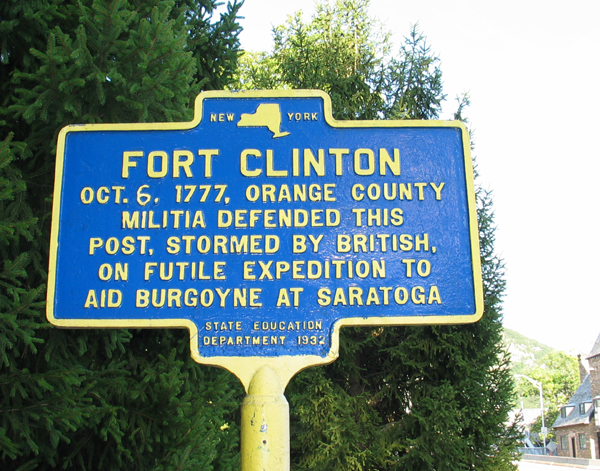
Click to enlarge sign at Fort Clinton.

Click to enlarge sign at Fort Clinton in the Revolutionary War

The sign reads:
Fort Clinton
Oct. 6, 1777, Orange County
Militia Defended this
Post, stormed by British,
On futile Expedition to,
Aid Burgoyne at Saratoga

Fort Clinton was constructed on the south side of Popolopen Creek on a rocky ridge overlooking the Hudson River below, oriented to cover a 400-yard wide plain before the drop to the waterway.

Fort Montgomery also overlooked the Hudson River, but was situated on the northern shore of Popolopen Creek, which ran west from the Hudson . . . Learn more about the American Revolution in the Hudson River Valley and the Battles at Fort Clinton and Fort Montgomery.


Battles Of The Revolutionary War : 1775-1781 by W.J. Wood (Dec 23, 2003)

    "Now began what could be called the campaign of the Clintons . Sir Henry was opposed by an American Clinton, Major General George Clinton, who was also governor of New York. The governor had a brother, Brigadier General James Clinton. George commanded Fort Montgomery; James commanded Fort Clinton.

    "Sir Henry left 1,000 men at Verplanck's Point and with the remaining 2,000 moved up the west side of the Hudson, sending 900 men under Lieutenant Colonel Campbell against Fort Montgomery, while Sir Henry himself led the remainder to Fort Clinton. The British successfully stormed both forts, though suffering a combined loss of over 300 killed and wounded. The 600 Americans in the two forts took an even heavier proportion of losses: 250 killed, wounded, or missing."

Fort Clinton, Today
Today, the site of Fort Clinton is part of Bear Mountain State Park. Unfortunately, most of Fort Clinton was demolished during the construction of the Bear Mountain Bridge and nearby Route 9W.

Fort Montgomery, Today
Today, Fort Montgomery is an archeological site and a historic ruin. Fort Montgomery State Historic Site is a genuine vestige of our nation's struggle for independence. Visitors will see the actual foundations of the fort's buildings and remains of the fort's earthworks.

Visit Fort Montgomery and tour the remains of the 14-acre fortification, perched on a cliff overlooking the Hudson River. Visitors can learn about this important military post at the new Visitor Center. You can view original artifacts and weapons, large scale models of the fort and the attack, detailed mannequins frozen in poses of battle, and a fifteen minute movie of the 1777 assault.

  Also in Categories:
History of the Hudson Valley
Hudson River Towns
Hudson Valley
Local History

history, Battles of the American Revolution, American Revolution, American Revolutionary War, War of Independence, Battle Fort Clinton, Hudson Highlands, historic trails, Fort Montgomery historic trails, Fort Montgomery Visitor Center, American Revolution - Battle of Fort Montgomery

845-446-2134 
  Battles of the American Revolution
Battle of Fort Montgomery and Battle of Fort Clinton
Date: October 3, 1777
Between: British, German (Hessian), and Loyalist troops against American Continental Army
Location: Fort Montgomery and Fort Clinton in Bear Mountain

"To aid Lieutenant General John Burgoyne's British army stalled at Saratoga, Lieutenant General Sir Henry Clinton sailed from New York with 3,000 British, German, and Loyalist soldiers and a flotilla of warships. On the morning of October 6, 1777, Clinton landed 2,100 of his men on the west side of the Hudson River near Stony Point. This force followed a narrow trail through the mountains, where they ran into a party of 30 men sent from Fort Clinton to detect the British advance. After beating the Americans back, Sir Henry Clinton sent 900 men around Bear Mountain to attack Fort Montgomery. The rest would wait to attack Fort Clinton until the first group had reached Fort Montgomery."

    The invasion of the Hudson Highlands had begun .

    On October 6, 1777, the Battle of Fort Montgomery lasted all afternoon before the British finally overran the badly outnumbered garrison of Forts Clinton and Montgomery. So valiant was the defense, that fully half the American force was killed, wounded or taken prisoner. The small American fleet and the iron chain were destroyed, and the river lay open to Sir Henry Clinton's forces.

    "On the afternoon of October 6, 1777, the British began an assault on both forts, which were defended by no more than 700 men. At Fort Montgomery, the Americans kept the British at bay as the two sides exchanged musket fire. When the Americans refused to surrender, the British stormed both forts. Taking advantage of the growing dark and the smoky haze from the battle, many of the Americans escaped, but as many as 275 were taken as prisoners to New York City where they remained for much of the war."

When the battles of the "twin" forts was over, the British destroyed Fort Montgomery, left British troops at Fort Clinton, and burned Kingston, the capital of New York. Then, receiving orders to join Sir William Howe's army near Philadelphia, Clinton's men destroyed Fort Clinton and sailed back down the Hudson. Although captured and destroyed, the forts had presented enough of an obstacle to keep the British forces in New York from aiding Burgoyne's army. The following year, in 1778, the American began rebuilding their defenses, this time at West Point.
    "Sir Henry Clinton's fleet sailed north and burned the state's capitol at Kingston. Then, news that General Burgoyne's army had been completely defeated brought Clinton's expedition to an abrupt end. Despite the success of his part of the campaign, Clinton was forced to return to New York City. Behind him, he left Forts Montgomery and Clinton in ruins."
Information Source
The history of Fort Montgomery and Fort Clinton, during the American Revolutionary War, a War of Independence between the Americans and England, is sourced from interpretive signs at the Fort Montgomery Visitor Center and on the Fort Montgomery and Fort Clinton historic trails.
  Also in Categories:
History of the Hudson Valley
Hudson River Towns
Hudson Valley
Local History

American Revolution, Revolutionary War, Hudson River, Fort Montgomery, Popolopen Creek, iron chain, Fort Montgomery State Historic Site, Chain at West Point, Fort Montgomery chain, New York State Parks, American Revolution in the Hudson River Valley American Revolution - Chaining the Hudson

 
  Click to enlarge the sign Chaining the Hudson in the American Revolution.

Click to enlarge sign about Chaining the Hudson in the American Revolution

The sign reads:
Chaining the Hudson
"Early in the Revolutionary War, the Continental Congress realized that if the British controlled the Hudson River, they could divide the rebellious colonies. To prevent this, in March 1776, the Americans began construction of Fort Montgomery above the Popolopen Creek on the west side of the Hudson River. Their work soon expanded to include a second fort, Fort Clinton, on the south side of the creek, and a massive iron chain that stretched across the Hudson River.

"Lieutenant Thomas Machin, one of the Continental Army's most able engineers, directed the work on the forts and the chain. During two separate attempts, the chain quickly broke under the strain of the ebb tide. Convinced that the chain could still work, Machin had the damage repaired and successfully stretched the chain across the river in march 1777.

"British ships never tested the chain. Rather, the British captured the forts on October 6, 1777, and cut the chain the following day. Today, Fort Montgomery State Historic Site is open to the public and interprets the story of the forts and the battle."

Click to enlarge sign: The First Chain along the Hudson River.

Click to enlarge sign The First Chain along the Hudson River. The sign reads:
The First Chain
Planned to keep British
Ships from going up
River. Anchored on shore
Below, was forced by the
Enemy Oct. 7, 1777


Chain at West Point
After the British destroyed the Fort Montgomery chain, the Americans created an even bigger chain at West Point, which was never challenged by the enemy. The diagram on the interpretive sign is courtesy of the West Point Museum Collection, United States Military Academy.

Fort Montgomery as a Historic Ruin
Rather than rebuild Fort Montgomery, New York State Parks has chosen to preserve and interpret it as a ruin. The site includes an interpretive trail that guides visitors past the fort's ruins to breathtaking vies of the Hudson River.

Find out more about the American Revolution in the Hudson River Valley.

  Also in Categories:
History of the Hudson Valley
Hudson River Towns
Hudson Valley
Local History

10922, History, American Revolution, American Revolutionary War, American War for Independence, War of the Revolution, iron chain, Hudson River Valley, historic ruin, Historic Site, historic trails, historical accounts, historic, Battle of Fort Montgomery American Revolution - Fort Montgomery "State Historic Site"

845-446-2134 
  Fort Montgomery State Historic Site is located in Fort Montgomery, New York 10922 in the historic Hudson River Valley.

Information Source
The history of Fort Montgomery and Fort Clinton during the American Revolutionary War; a War of Independence between the Americans and England, is sourced from interpretive signs at the Fort Montgomery Visitor Center and on the Fort Montgomery historic trails.

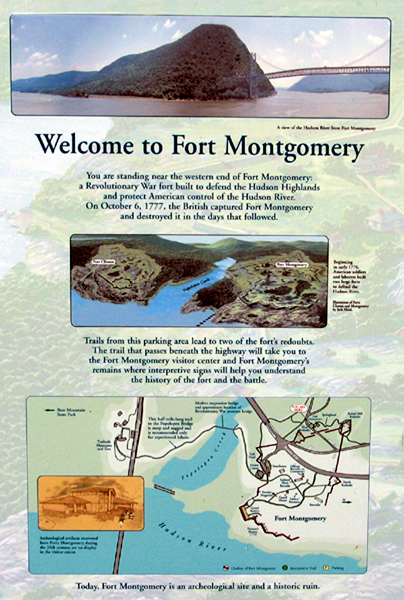
Click to enlarge sign about Fort Montgomery in the American Revolution.

Click to enlarge sign about Fort Montgomery in the American Revolution

The interpretive sign reads:
Welcome to Fort Montgomery
"You are standing near the western end of Fort Montgomery:
a Revolutionary War fort built to defend the Hudson Highlands
and protect American control of the Hudson River.
On October 6, 1777, the British captured Fort Montgomery
and destroyed it in the days that followed.

"Trails from this parking area lead to two of the fort's redoubts.
The trail that passes beneath the highway will take you to
the Fort Montgomery visitor center and Fort Montgomery's
remains where interpretive signs will help you understand
the history of the fort and the battle."

Today, Fort Montgomery is an archeological site and a historic ruin.

Fort Montgomery was the scene of a fierce battle for control of the Hudson River during the American Revolutionary War; the Hudson was considered strategic by both the Americans and the British during the American War for Independence.


Building Fort Montgomery and Fort Clinton
"Early in the Revolutionary War, the Continental Congress realized that the Hudson River was critical to the American cause. If the British controlled the river, they could divide the rebellious colonies. Therefore, the Americans began work on Fort Montgomery in March 1776. . .

    " . . . When the Americans discovered that the land on the opposite side of the Popolopen Creek was higher and would threaten Fort Montgomery if held by the enemy, they began constructing a second fort there, called Fort Clinton. They connected the two forts by a pontoon bridge. . .

    "Fort Montgomery was a bustling community of hundreds of people. Soldiers, laborers, merchants, families, servants, and slaves lived at or visited the fort. Ships and boats arriving and departing added to the atmosphere of a small city.

    "Supplies were often hard to obtain, morale was often low, and discipline was a chronic problem. Nevertheless, Forts Montgomery and Clinton were largely complete by October 1777, when the British attacked them."

    Fort Clinton
    "Originally, the commissioners in charge of the work were confident that no overland attack on the fort was possible, but misgivings led them to begin extending the fortifications inland. They began fortifying several pieces of high ground that became Fort Montgomery's three redoubts. The realization that a higher piece of ground just across the Popolopen Creek threatened Fort Montgomery led to the construction of Fort Clinton."

Click to enlarge sign about the Battle of Fort Montgomery in the American Revolution.

Click to enlarge sign about the Battle of  Fort Montgomery in the American Revolution The interpretive sign reads:
Battle of Fort Montgomery
"To aid Lieutenant General John Burgoyne's British army stalled at Saratoga, Lieutenant General Sir Henry Clinton sailed from New York with 3,000 British, German, and Loyalist soldiers and a flotilla of warships. On the morning of October 6, 1777, Clinton landed 2,100 of his men on the west side of the Hudson River near Stony Point. This force followed a narrow trail through the mountains, where they ran into a party of 30 men sent from Fort Clinton to detect the British advance. After beating the Americans back, Sir Henry Clinton sent 900 men around Bear Mountain to attack Fort Montgomery. The rest would wait to attack Fort Clinton until the first group had reached Fort Montgomery.

"In the afternoon, the British began an assault on both forts, which were defended by no more than 700 men. At Fort Montgomery, the Americans kept the British at bay as the two sides exchanged musket fire. When the Americans refused to surrender, the British stormed both forts. Taking advantage of the growing dark and the smoky haze from the battle, many of the Americans escaped, but as many as 275 were taken as prisoners to New York City where they remained for much of the war.

"Following the battle, the British destroyed Fort Montgomery, garrisoned Fort Clinton, and burned New York's capital at Kingston. Then, receiving orders to join Sir William Howe's army near Philadelphia, Clinton's men destroyed Fort Clinton and sailed back down the Hudson. Although captured and destroyed, the forts had presented enough of an obstacle to keep the British forces in New York from aiding Burgoyne's army. The following year, in 1778, the American began rebuilding their defenses, this time at West Point."


Click to enlarge photo of the Wounded Patriot at the Battle of Fort Montgomery.

Click to enlarge photo of the Wounded Patriot at the Battle of Fort Montgomery Men in the photo represent two American patriots: Private, Ulster County Militia, and Private, 5th New York Regiment. The militiaman, in civilian clothing, is armed with a British musket. He assists his wounded comrade carrying a French musket from the 1750s.

The American Revolution - 1777: History of Fort Montgomery and Fort Clinton
The following historical accounts record the Battles of Fort Montgomery and Fort Clinton from different historical perspectives:

The War of the Revolution , by Christopher Ward, Volume II (Macmillan, 1952)

"An opaque fog lay close to the surface of the Hudson River on the morning of October 5, 1777. The awakening bugles of General Israel Putnam’s Continentals at Peekskill on the eastern shore of the river seemed muted by the white and misty blanket. The slow-rising sun burned irregular holes in it, however, and through these the General’s sentinels, who had been posted south of his encampment during most of the summer, saw something that banished their accustomed boredom. There were barges and galleys downriver—many of them—and above the low lying haze rose the towering masts of British frigates. From downriver, too, came the muffled sounds of alarm guns. The long-dreaded invasion of enemy troops from occupied New York had begun.

The elderly Yankee Israel Putnam was busy at once. An oarsman, rowing desperately, bore messages across the wide stream to Fort Montgomery, an unfinished cluster of earthworks then under the command of the thirty-eight-year-old governor of the new state of New York, Brigadier General George Clinton. At this bastion, nearly a hundred and fifty feet above the spot where the Popolopen Creek joins the Hudson, the Governor received Putnam’s letter. Immediately he sent a summary of its contents to his older brother, General James Clinton, then in command of Fort Clinton, a smaller stronghold on the steep south bank of the narrow creek.

In the meantime, the British under Sir Henry Clinton (a distant cousin of the American generals of the same surname) were disembarking at Verplanck’s Point on the east bank of the Hudson, not far below Putnam’s headquarters. The grating of their boats in the shallows of the river, the sharp voices of their officers ordering immediate formations, came strangely through the thick fog to the ears of Putnam’s scouts, informing them only that the invaders were in considerable numbers . . .

. . . Perhaps the Battle of Fort Montgomery would have been utterly neglected had not two young American soldiers chosen to visit the site on a sunny spring day of the following year. Historians do not usually end their chapters on such footnotes as these men provided, but their reports have so documented the narrative that they deserve place here. One of them, a young chaplain named Timothy Dwight (later president of Yale College), wrote in his journal that while he was climbing from a river barge to the place where the battle had been fought, the stench of dead bodies caused him great distress.

We found, at a small distance from Fort Montgomery, a pond of a moderate size, in which we saw the bodies of several men, who had been killed in the assault upon the fort. They were thrown into this pond, the preceding autumn, by the British … Some of them were covered at this time; but at a depth so small as to leave them distinctly visible. Others had an arm, a leg, or a part of the body, above the surface. The clothes which they wore when they were killed, were still on them, and proved that they were militia; being the ordinary dress of farmers. Their faces were bloated and monstrous; and their postures were uncouth, distorted and to the highest degree afflictive . . ."

Battles Of The Revolutionary War : 1775-1781 by W.J. Wood (Dec 23, 2003)

"On October 6th, 300 Continental soldiers of the 5th New York regiment, 100 artillerymen of Lamb's Artillery, and some 300 Levies and militiamen defended the unfinished Fort Montgomery and Fort Clinton against a combined force of roughly 2,100 Loyalists, Hessians, and British regulars led by Lieutenant General Sir Henry Clinton attacked Forts Montgomery and Clinton from the landward side (which was only partially completed) with support from cannon fire from British ships on the Hudson River. The land columns attacking from west of the fort consisted of the New York Volunteers, the Loyal American Regiment, Emmerich's Chasseurs, the 57th and the 52nd Regiments of Foot.

The Americans had emplaced an iron chain and a boom across the Hudson River, protected by four warships, to impede the British flotilla.

Lt. Col. Mungo Campbell and several British regulars approach the fort with a flag of truce indicating that they wish to avoid `further effusion of blood.' Clinton sends Lt. Col. William S. Livingston to meet the enemy. The British officer requests that the patriots surrender. They are promised that no harm would come to them. Livingston, in turn, invites Campbell to surrender and promises him and his men good treatment. Fuming at this audacity, the British resume the fight. British ships working against an ebb tide attack the forts and American vessels. A steady volley ensues with each side receiving a share of the bombardment. British officers Campbell and Vaughan close in on all sides of the twin forts. Leading his men into battle, Campbell is killed in a violent attack on the North Redoubt of Fort Montgomery. Vaughan's horse is shot from under him as he rides into battle at Fort Clinton.

After a fierce battle lasting until dark, the British pushed the courageous Americans from the forts at the points of their bayonets. The defenders are overpowered by sheer numbers and the British gain possession of Forts Montgomery and Clinton. American casualties numbered about 350 killed, wounded and captured, while the British paid a price of at least 190 killed and wounded. Those who were not killed or did not escape are shipped to the infamous Sugar House Prisons in New York City and then onto British "hell ships" (prison ships) in the harbor. A "return," or report of prisoners, is sent to communities in the Highlands to inform families of their loved ones' capture. It is up to the families to send provisions lest the prisoners starve. Countless patriots perish on the prison ships.

U.S. Army battle map, The Battle of Fort Montgomery, 5-6 October 1777 U.S. Army battle map, The Battle of Fort Montgomery, The British Attack, Dusk, 6 October 1777 Forts Montgomery and Clinton, located just south of West Point, were built for the defense of the Hudson Highlands in 1776. It was here that British and loyalist troops overwhelmed Clinton's outnumbered patriots in October.

Although the Americans lost the battle for the Highlands, a relative handful of Americans aided in delaying British reinforcements from joining Burgoyne in the upper Hudson Valley and allowed Gates to gain much needed militia reinforcements in time to ultimately win Burgoyne's surrender at Saratoga."

A guide to the Battles of the American Revolution by Theodore P. Savas and J. David Dameron (Savas Beatie LLC, NY 2006)

American Perspective:
"Waiting within the American fortifications on Bemis Heights was the bloodied Continental Army led by Maj. Gen. Horatio Gates. Not an audacious commander, Gates was content to await General Burgoyne's next move. While Gates market time on Bemis Heights, Patriot forces assigned to defensive positions guarding the entrance to the Hudson Highlands worked to complete two forts on the Hudson River 100 miles south of Albany, New York. Their commander was Brig. Gen. George Clinton (not to be confused with the British commander with the same last name). The forts over which the American Clinton (who was also governor of New York) labored were named Montgomery, in honor of fallen Patriot Gen. Richard Montgomery, and Clinton, after himself as commander of the forces in that region. Built on opposite banks of Popolopen Creek, which emptied into the Hudson River on its western shore at a strategic bend, eight miles south of West Point, the bastions were key to the strategic defense of the Hudson Highlands.

Fort Montgomery guarded the northern bank of the creek and Fort Clinton the southern bank. To the east of both forts flowed the majestic Hudson River. All told, the American fielded 600 men and 20 pieces of heavy artillery. The Patriots strung a heavy iron chain across the river and seeded the water with log obstacles to disrupt any maritime assault upon the American forts. Patrolling the Hudson were two Americans warships, Montgomery and Congress, supported by a handful of smaller vessels . . .

. . . Fort Clinton was constructed on the south side of Popolopen Creek on a rocky ridge overlooking the Hudson River below, oriented to cover a 400-yard wide plain before the drop to the waterway. Fort Montgomery also overlooked the Hudson River, but was situated on the northern shore of Popolopen Creek, which ran west from the Hudson . . .

After a perfunctory request that the defenders capitulate (which was rejected), the twin assaults began. There was no element of surprise or effort at finesse. The British attached nearly simultaneously with the sun setting behind Lt. Col. Archibald Campbell's columns. Sir James Wallace's British river fleet also arrived and opened fire on the American vessels and forts, providing the British land forces with supporting fire.

Fort Montgomery fell first . . . Fort Clinton's defenders offered a better account of themselves, but the outcome was the same. Sir Henry Clinton ordered his command to launch a direct attach (there was little room to maneuver). His regulars and Hessian allies swept forward through a line of obstructions, taking terrible casualties during the approach and in the close-quarter fighting that followed. The weight of British metal carried the day, however, and within a short time the garrison was dead, wounded, captured, or fleeing . . .

By 7:30 or 8:00 p.m. the fighting was over. Only 300 Americans, including Generals James and Governor George Clinton, escaped, most from Fort Montgomery . . . Casualties: British: 190 killed and wounded; American: 350 killed, wounded, and captured."

Fort Montgomery as a Historic Ruin
New York State Office of Parks, Recreation and Historic Preservation has decided not to recreate Forts Montgomery and/or Clinton. "Because of the limits of available information, any recreation would be inaccurate and would hide the violent end of these massive fortifications. Instead, the remains are preserved, just as the have survived the ages, as hallowed ground."

    Fort Montgomery stands as an archeological site and a historic ruin.


Fort Montgomery, Today
Today, Fort Montgomery is an archeological site and a historic ruin. This Historic Site is a genuine vestige of our nation's struggle for independence. Visitors will see the actual foundations of the fort's buildings and remains of the fort's earthworks. Visit Fort Montgomery and tour the remains of the 14 acre fortification, perched on a cliff overlooking the Hudson River.

The site includes a Visitor Center and interpretive trail that guides visitors past the fort's ruins to breathtaking views of the Hudson River. The Visitor Center features artifacts discovered in Fort Montgomery, mannequin displays, a 3 dimensional map model, and a 14 minute orientation film.

Attractions Include
Audio-Visual Programs
Demonstrations
Group Tours
Hiking
Interpretive Signs
Scenic Views
Self Guided Tours
Visitor Center

  Also in Categories:
Activities | Attractions | Places to Go
Attractions | Places To Go
Attractions | Places to Go | Activities
Children | Kids - Activities | Attractions
Children | Kids - Attractions
Children | Kids - Educational Activity | Websites
Children | Kids - Things To Do
Children's Birthday Party | Kid's Birthday Parties
Historic Sites | History
History of the Hudson Valley
Hudson River Towns
Hudson Valley
Local History
Things To Do | Activities

American Revolution - Fort Montgomery Chain

 
  Click to enlarge photo of Fort Montgomery Chain.

Click to enlarge photo of Fort Montgomery Chain

The sign reads:
"Drawing of the chain and its log floats stretched across the Hudson River at Fort Montgomery, January 7, 1777. After the British destroyed the Fort Montgomery chain, the Americans created an even bigger chain at West Point, which was never challenged by the enemy. Courtesy of the West Point Museum Collection, United States Military Academy."

Press blue button for more about the American Revolution in the Hudson Valley.

  Also in Categories:
History of the Hudson Valley
Hudson Valley
Local History
Mid-Hudson Valley

photo, Fort Montgomery, West Redoubt, Fort Montgomery West Redoubt, fort, British, Governor Clinton, battle October 6, 1777,  Loyalist soldiers, British soldiers, British and Loyalist soldiers, Brigadier General George Clinton American Revolution - Fort Montgomery West Redoubt

845-446-2134 
  Fort Montgomery West Redoubt in the American Revolution.

Click sign at the Fort Montgomery West Redoubt.

Click to enlarge photo of Sign at Fort Montgomery West Redoubt. The sign reads:
Fort Montgomery's West Redoubt
"Fort Montgomery's West Redoubt was one of three strong points built to defend the fort from an overland attack.

"New York State's Governor, Brigadier General George Clinton, commanded Fort Montgomery during the battle on October 6, 1777. Clinton ordered his men into the fort's three redoubts, where they were attacked by 900 British and Loyalist soldiers. After mounting a brave resistance, the Americans were driven from the redoubts and were forced to abandon the fort."

One of the drawings in the sign shows that: "Aware that the British were approaching, Governor Clinton ordered some of his men to take a 3-pounder cannon down the road that lead to the fort and delay them. The Americans were able to temporarily stop the advancing British and Loyalist soldiers, but were eventually forced to abandon the gun and return to the fort."

  Also in Categories:
Activities | Attractions | Places to Go
Attractions | Places To Go
Attractions | Places to Go | Activities
Children | Kids - Activities | Attractions
Children | Kids - Attractions
Children | Kids - Educational Activity | Websites
Children | Kids - Things To Do
Children's Birthday Party | Kid's Birthday Parties
Historic Sites | History
History of the Hudson Valley
Hudson River Towns
Hudson Valley
Local History
Things To Do | Activities

photo, American Revolution, Historic 1777 & 1779 Trails, Fort Montgomery Historic Site, Bear Mountain Bridge, Fort Montgomery Visitor Center, Revolutionary War, Forts Clinton and Montgomery, Stony Point, Continental Army's victories American Revolution - Historic Trail of 1777 & 1779

845-446-2134 
 
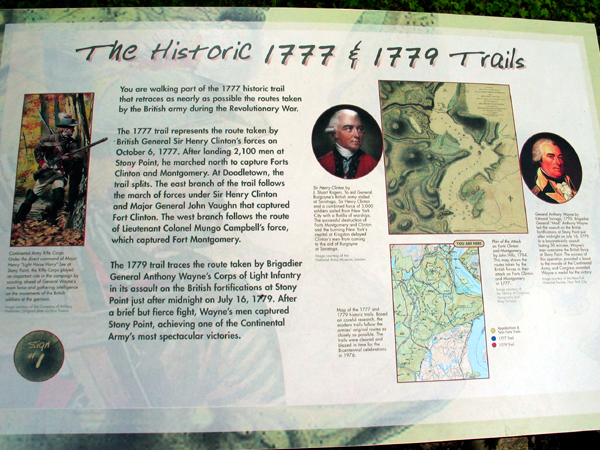
Click trail marker for the Historic 1777 & 1779 American Revolution Trail.

Click to enlarge photo of Historic 1777 & 1779 American Revolution Trail marker.

The sign reads:
The Historic 1777 & 1779 Trails
"You are walking part of the 1777 historic trail that retraces as nearly as possible the routes taken by the British army during the Revolutionary War.

"The 1777 trail represents the route taken by British General Sir Henry Clinton's forces on October 6, 1777. After landing 2100 men at Stony Point, he marched north to capture Forts Clinton and Montgomery. At Doodletown, the trail splits. The east branch of the trail follows the march of forces under Sir Henry Clinton and Major General John Vaughn that captured Fort Clinton. The west branch follows the route of Lieutenant Colonel Mungo Campbell's force, which captured Fort Montgomery.

"The 1779 trail traces the route taken by Brigadier General Anthony Wayne's Corps of Light Infantry in its assault on the British fortifications at Stony Point just after midnight on July 16, 1779. After a brief but fierce fight, Wayne's men captured Stony Point, achieving one of the Continental Army's most spectacular victories."

Walk the grounds of the Historic 1777 & 1779 Trails at Fort Montgomery Historic Site. You can pick up the 1777 & 1779 trails close to the Bear Mountain Bridge and/or near the Fort Montgomery Visitor Center.

  Also in Categories:
Activities | Attractions | Places to Go
Attractions | Places To Go
Attractions | Places to Go | Activities
Children | Kids - Activities | Attractions
Children | Kids - Attractions
Children | Kids - Educational Activity | Websites
Children | Kids - Things To Do
Children's Birthday Party | Kid's Birthday Parties
Historic Sites | History
History of the Hudson Valley
Hudson River Towns
Hudson Valley
Local History
Things To Do | Activities

Chaining the Hudson, Fort Montgomery chain, American invasion of Canada, Fort Montgomery chain, American Revolution in the Hudson Valley American Revolution - Map of Hudson River Chain

 
  Click to enlarge photo of Chaining the Hudson.

Click to enlarge photo of Chaining The Hudson map

The sign reads:
"A portion of the Fort Montgomery chain was origninally constructed to block the Richelieu River. It was carried far to the north only to return south when the American invasion of Canada failed in early 1776. The Americans considered using it at Fort Ticonderoga to block Lake Champlain, but chose instead to return it to the Hudson River to become part of the Fort Montgomery chain."

Press blue button for more about the American Revolution in the Hudson Valley.

  Also in Categories:
History of the Hudson Valley
Hudson Valley
Local History
Mid-Hudson Valley
 All Vails Gate Listings

 Vails Gate American Revolution | American War of Independence

12584, Historic Site, Orange County, Hudson River Valley, Revolutionary War, military headquarters, General Washington, Hudson River, New York City, fun for the children, children Knox's Headquarters "State Historic Site"

845-561-5498 
  Knox's Headquarters State Historic Site is located at Vails Gate, NY 12584 in Orange County in the Hudson River Valley. On several occasions during the Revolutionary War, Major General Henry Knox, Commander of the America artillery, established his military headquarters at John Ellison's 1754 Georgian-style house in Vails Gate. From October 1782 until the spring of 1783, as 7,000 soldiers and 500 "camp followers" were establishing winter quarters at the New Windsor Cantonment, and General Washington was lodged at Jonathan Hasbrouck's house in Newburgh, New York, Major General Horatio Gates occupied the elegant home from which he commanded the cantonment. Here the army awaited the end of the Revolutionary War that became effective when Washington issued the cease fire orders on April 19, 1783.

For most of the 18th and into the 19th century, the Ellison family had important commercial dealings in milling and trade. From their mill, flour was shipped down the Hudson River to New York City and the West Indies. At present, remains of the mill, with traces of the underground racecourse, and the Jane Colden Native Plant Sanctuary may be visited. Explore how the Ellisons and other families of the mid-Hudson Valley lived 200 years ago.

Point of Interest Knox's Headquarters State Historic Site is fun for the children and family of all ages.

Attractions
Costumed Interpreters
Demonstrations
Educational Services
Gardens
Group Tours
Guided Tours
Hiking
Interpretive Sign
Picnic Area
Re-enactments
Scenic Views

  Also in Categories:
Activities | Attractions | Places to Go
Attractions | Places To Go
Attractions | Places to Go | Activities
Children | Kids - Activities | Attractions
Children | Kids - Attractions
Children | Kids - Educational Activity | Websites
Children | Kids - Things To Do
Children's Birthday Party | Kid's Birthday Parties
Hiking Trails | Walking Trails
Historic Sites | History
History of the Hudson Valley
Local History
Outdoor Activities | Things To Do
Picnicking | Picnic
Things To Do | Activities

12584, Historic Site, Orange County, Hudson River Valley, General George Washington, War of Independence, fun for children, kids, children, Attractions, Educational Services, Hiking, Picnic Area, Scenic Views New Windsor Cantonment "State Historic Site"

845-561-1765 
  New Windsor Cantonment State Historic Site is located at Vails Gate, NY 12584 in Orange County in the Hudson River Valley. In October 1782, General George Washington moved his army to New Windsor, above West Point and just beyond the Hudson Highlands, to establish winter quarters. He was accompanied by 7,000 troops including 500 women and children or "camp followers." By late December 1782, they had erected nearly 600 log huts into a "cantonment," a military enclave. High-ranking officers were quartered in private homes.

Washington was pleased that the army was better housed, fed, and clothed than ever before in the long war, but life for the officers and troops at the Cantonment remained hard. It was at the New Windsor Cantonment that the cease fire orders were issued by Washington ending the eight-year War of Independence on April 19, 1783. The final success, however, was the gradual, orderly disbandment of the army at the Cantonment, and the peaceful march of its still largely unpaid officers and men back to their homes or new pursuits.

New Windsor Cantonment State Historic Site is fun for children and family. See the staff in reproduction period dress and uniforms demonstrate musket drills, blacksmithing, military medicine and camplife activities. View the exhibits at the Visitor Center and the reconstructed Temple Building, which served as a chapel for the soldiers.

Attractions
Audio-Visual Programs
Costumed Interpreters
Demonstrations
Educational Services
Group Tours
Guided Tours
Hiking
Interpretive Sign
Picnic Area
Re-enactments
Scenic Views
Self Guided Tours
Visitors Center/Museum

The word is Wonderful day out for the kids and children of all ages.

  Also in Categories:
Activities | Attractions | Places to Go
Attractions | Places To Go
Attractions | Places to Go | Activities
Children | Kids - Activities | Attractions
Children | Kids - Attractions
Children | Kids - Educational Activity | Websites
Children | Kids - Things To Do
Children's Birthday Party | Kid's Birthday Parties
Gardens, Nature Centers & Trails
Hiking Trails | Walking Trails
Historic Sites | History
History of the Hudson Valley
Local History
Outdoor Activities | Things To Do
Picnicking | Picnic
Things To Do | Activities


American Revolution
American War of Independence
Hudson River Valley

The American Revolution, also known as the American War of Independence, spanned eight long years of fighting and political negotiations between Britain and her colonies. On October 19, 1781, the Americans, with the help of French troops under the French Count de Rochambeau, won a major battle at Yorktown, Virginia. Cornwallis, leader of the British troops, surrendered 7,000 men. However, the final struggle of the American War of Independence was yet to come.

Two years later, in September, 1783, after much diplomacy, the Treaty of Paris was signed and the former 13 colonies were recognized as an independent nation; the United States of America was born.

Read about the American Revolution from different perspectives, written at different times in history, by different historians. Historical works used as a source for this section, may be accessed online and read in its entirety.

The American Revolution
Learn about The American Revolution and its several phases, including: Causes of the American Revolution; Outbreak of the American Revolution; Formation of the Continental Army; the Invasion of Canada and Fall of Boston; and The New Nation. Followed by a summary of The Winning of Independence, 1777-1783.

Summary of The American Revolution and its impact on the Hudson River Valley
The American Revolution was a conflict between 13 British colonies on the eastern shores of North America, and their mother country, Great Britain. The American Revolution, also known in history as the "American War of Independence", lasted from 1775 to 1783. Eventually, the colonies won the war against the British and became a separate nation called "The United States of America". The American victory over the British ended two centuries of British rule over most of the North American Colonies, resulting in the formation of the United States of America.

One of the causes of the American Revolution can be traced to the end of the French and Indian War, 1755 - 1762; fought in Europe, India and the West Indies. Britain's victory in the French and Indian War, forced the French out of Canada, thereby allowing the British to assume government of the French population. With the additional territory won from France, Britain's enormous national debt was increased. The British victory also released the American colonies from the threat of a French invasion.

In an attempt to relieve Britain of its financial burden, British Parliament decided that the American Colonists would have to help pay for their own defense, despite the fact that a French invasion was no longer a real threat. Toward this end, British Parliament passed the first of several tax laws, including the Stamp Act, which taxed all paper products in the colonies. The Americans declared it was unfair to tax them when they had no representation in Parliament, and protests eventually escalated to open hostilities in 1775, when the British Regulars fired on the Minutemen in Lexington, Massachusetts.

Battles of the American Revolution
The American Revolution started in 1775 when the British government decided to use overwhelming military force to crush the American revolt in Boston at the Battle of Concord and Lexington, April 19, 1775. The "fighting" in the American Revolution ended in Virginia with the Battle of Yorktown, September 28th to October 19, 1781; where General George Washington defeated the army of Lord Cornwallis, bringing victory to the Americans and an end to the Revolutionary War.

The years between saw many battles in the Hudson River Valley that served as a strategic area of defense for the American revolutionaries. The Hudson River, a highway between revolutionary forts and encampments in the Hudson Highlands, was used by the British to sail large numbers of British and German (Hessian) troops to attack the American encampments and forts.

The American Revolutionary battles of Fort Montgomery and Fort Clinton on October 6, 1777 were fought early in this long and difficult conflict. Fort Montgomery and Fort Clinton were built on both shores of the Popolopen Creek, which empties into the Hudson River a few miles above the first chain. In a further attempt to stop the British forces from invading and controlling this important waterway, the revolutionary forces "chained" an area of the Hudson south of West Point and north of Bear Mountain in what is known today as the hamlet of Manitou. The Americans placed the first Chain across the Hudson River in an attempt to further support the Hudson Highlands. Later in the war, a second chain that was never tried, was successfully installed further north, at West Point.

Fort Montgomery and Fort Clinton became the battleground of two fierce battles in the American Revolution. On October 6, 1777, approximately 700 American troops, comprised of 300 Continental soldiers, 100 artillerymen and 300 militiamen defended the "twin" forts against 2100 Loyalist, Hessian, and British regulars led by Sir Henry Clinton.

Although these two battles were won by the British; who then destroyed both forts and broke the first chain across the Hudson River; the battles sufficiently delayed British reinforcements from joining Burgoyne in the upper Hudson Valley. This allowed time for the Americans to gain desperately needed militia reinforcements, culminating in the defeat of the British in Saratoga with the surrender of General Burgoyne.

"To aid Lieutenant General John Burgoyne's British army stalled at Saratoga, Lieutenant General Sir Henry Clinton sailed from New York with 3,000 British, German, and Loyalist soldiers and a flotilla of warships. On the morning of October 6, 1777, Clinton landed 2,100 of his men on the west side of the Hudson River near Stony Point. This force followed a narrow trail through the mountains, where they ran into a party of 30 men sent from Fort Clinton to detect the British advance. After beating the Americans back, Sir Henry Clinton sent 900 men around Bear Mountain to attack Fort Montgomery. The rest would wait to attack Fort Clinton until the first group had reached Fort Montgomery."

On October 19, 1781, the Americans with the help of French troops under the French Count de Rochambeau, won a major battle at Yorktown, Virginia. Cornwallis, leader of the British troops, surrendered 7,000 men. However, the final struggle of the American War of Independence was yet to come.

Two years later, in September of 1783, after much diplomacy, the Treaty of Paris was signed. Great Britain signed the treaty in which the former 13 colonies were recognized as an independent nation; the United States of America was born.

History of the American Revolution
Following, are brief excerpts about the American War of Independence. These write-ups cover different sources from different periods of time. Each historical write-up focuses on different aspects of the American Revolution.

The following material is sourced from: The Everything American Revolution Book by Daniel P. Murphy, Ph.D. (2008) F+W Publications, Inc., MA.

    "The English colonies were unique in the new World. The Spanish and French colonies were governed by viceroys and governors who reported directly to their monarchs. Spanish and French colonists were unable to develop representative institutions. By contrast, the English colonies were largely self-governing. From an early date, the English colonists were able to establish legislatures that wielded real authority in local matters. This long-established tradition of American political autonomy lay at the heart of the dispute over taxation by the British government following the French and Indian War. . .

    "By seventeenth and eighteenth century standards, the original thirteen colonies were the most democratic polities in the world. The first Virginia House of Burgesses was elected by all males seventeen years of age and older, only later was the vote restricted to landowners. . . On average the property qualification to vote meant possession of fifty acres of land or property valued at 50 pounds sterling. Probably 50 percent of men in the south and 75% of men in the north could vote."

The following material is sourced from Our Country, Published in 1877 as "A Household History of the United States for All Readers," From the Discovery of America to the Present Time. Volume Two, By Benson J. Lossing, LL.D., (3 vols. New York: Johnson & Bailey, 1894)

    Time and Place: 1775, British Ministers in Parliament
    "There was now much fluttering among the ministers. Lord North, to the astonishment of everybody, submitted a sort of conciliatory plan that pleased nobody, yet he adroitly carried it through. Other plans, more favorable to the Americans, were offered and rejected. Franklin's "Hints" had been considered by the ministry, and propositions had been made to him which were so much short of justice that he replied, "While Parliament claims the right of altering American constitutions at pleasure, there can be no agreement, for we are rendered unsafe in English privilege." When it was suggested that an agreement was necessary for America, as it would be "so easy for Britain to burn all their seaport towns," the philosopher answered bravely: "My little property consists of houses in those towns; you may make bonfires of them whenever you please: the fear of losing them will never alter my resolution to resist, to the last, the claim of Parliament.

    "The British government, by its acts, had now virtually declared war against the English-American colonists as rebels. Abandoning all hope of reconciliation, Franklin returned to America in the spring of 1775, and entered vigorously upon the prosecution of the war that soon afterward broke out.

    "In the early part of 1775, the British government had proclaimed Massachusetts to be in a state of rebellion. and provided means for suppressing that rebellion by force of arms. The fulmination of wrathful threats against that province was intended for the ears of her sister colonies, as well as for her own. They had interest in common. They were making resistance to oppression in common; and they were resolved to stand united for the common defense. To call Massachusetts a 'rebel,' was to call all the other colonies 'rebels.' So they all felt. Joseph Hawley had said in Massachusetts, when viewing the impending crisis: 'We must fight!' Patrick Henry, in Virginia, answered 'Amen!' with vehemence; and these words from the head and heart of resistance to oppression, were echoed back from all the provinces in the early part of 1775. For ten years the people of those provinces had pleaded, remonstrated, and worked in vain endeavors to obtain justice for themselves and their posterity . . . . At length the united colonies came to the solemn conclusion - 'We must fight,' and prepared for the dire necessity. The war for independence that ensued was not a war of revolution on the part of the Americans. It was a war by the Americans against the arch revolutionist King George and his ministers - a war by the Americans for the defense of their liberties and free institutions which the government of Great Britain sought to destroy.

The following material is sourced from:
Microsoft® Encarta® Online Encyclopedia, http://encarta.msn.com © 1997-2009

    "In the fall of 1775 the British government decided to use overwhelming military force to crush the American revolt. The task looked easy. England, Wales, and Scotland had a combined population of about 9 million, compared with 2.5 million in the 13 rebel colonies, nearly 20 percent of whom were black slaves. Militarily, Britain was clearly superior, with a large standing army and the financial resources to hire additional troops, and the most powerful navy in the world. The British government also counted on mobilizing thousands of Loyalists in America and Native Americans who were hostile to white expansion.

    "Nonetheless, the Americans had a number of important advantages. They were fighting on their own territory, close to the sources of supply and amid a mostly friendly population. In addition, the Patriots had some resourceful military leaders, who had been tested in the French and Indian War. Finally, later in the war, the rebellious colonies received crucial aid from France and Spain. This assistance offset British superiority in wealth and military power, and made possible a clear-cut American victory. However, few of these American advantages were obvious when the war began.

    "Throughout the war, one of the main challenges facing the Americans was maintaining a credible army. Washington’s main Continental Army never had more than 24,000 active-duty troops, although Congress promised to raise a force at least three times that size. In addition, the army was poorly supplied and short on weapons and food. Early in the war General Philip Schuyler of New York complained that his men were “weak in numbers, dispirited, naked, destitute of provisions, without camp equipage, with little ammunition, and not a single piece of cannon.” The situation did not improve during the course of the war. Because of the meager financial support provided by Congress and the American people, the Continental Army almost perished from hunger and cold during the winters of 1777 and 1778. Inadequate pay prompted mutinies in the ranks and in the officer corps as late as 1783. The Continental Army had to struggle to survive during the entire war.

    "If inadequate support was one weakness of the Continental Army, its composition was another. The army was a new creation, without tradition or even military experience. Trained militiamen wanted to serve in local units near their farms and families, so raw recruits formed the basis of the Continental forces. Muster rolls for troops commanded by General William Smallwood of Maryland show that they were either poor American-born youths or older foreign-born men, often former indentured servants. Some of these men enlisted out of patriotic fervor; many more signed up to receive a cash bonus and the promise of a future land grant.

    "It took time to turn such men into loyal soldiers. Many panicked in the heat of battle. Others deserted, unwilling to accept the discipline of military life. Given this weak army, Washington worried constantly that he would suffer an overwhelming defeat.

    "In total, the war lasted for eight years and had four phases, each with a distinct strategy and character. During the first phase, from April 1775 to July 1776, the Patriots’ goal was to turn the revolt into an organized rebellion, while British governors and armed Loyalists tried to suppress the uprising. The second phase of the war began with a major British invasion of New York in July 1776 and ended with the American victory at Saratoga in October 1777. The British strategy was to confront and defeat the Continental Army and to isolate the radical Patriots of New England. Washington’s goal was to protect his weak forces by retreat and, when he held the advantage, to counterattack. During the third phase of the war Britain tried to subdue the South. Beginning in early 1778 it used regular troops to take territory and local Loyalists to hold it. Patriots used guerrilla warfare to weaken British forces, and then used French assistance to win a major victory at Yorktown, Virginia, in October 1781. Then came the final phase of the war when astute Patriot diplomacy won a treaty recognizing the independence of the United States in September 1783."

Sources
The Everything American Revolution Book by Daniel P. Murphy, Ph.D. (2008) F+W Publications, Inc., MA.

Our Country, Published in 1877 as "A Household History of the United States for All Readers," From the Discovery of America to the Present Time. Volume Two, By Benson J. Lossing, LL.D., (3 vols. New York: Johnson & Bailey, 1894)

The American Revolution: First Phase, Extracted from: American Military History, Center of Military History, United States Army, Washington, DC 1989

The Winning of Independence, 1777-1783, Extracted from: American Military History, Center of Military History, United States Army, Washington, DC 1989

Microsoft® Encarta® Online Encyclopedia, http://encarta.msn.com © 1997-2009


Top of Page